How Long Does SaaS SEO Take to Show ROI? A Month-by-Month Timeline
B2B SaaS SEO typically breaks even around month 7, with early traffic movement visible by month 3, and full compounding ROI (First Page Sage reports 702% for B2B SaaS specifically) building out over 12-24 months. This isn’t a fixed rule — domain authority, keyword competitiveness, and budget consistency all shift the timeline — but the pattern across independent studies is consistent enough to plan a budget around.
Why This Question Deserves a Real Answer
Founders asking “how long until SEO pays off” usually get one of two unhelpful answers: a vague “it depends,” or an aggressive sales pitch promising results in 30 days. Neither is honest. SEO is a compounding channel, closer to building equity than flipping a paid ad on and off — but that doesn’t mean the timeline is unknowable. Multiple independent studies converge on a similar shape, which makes it possible to set real expectations instead of guessing.
Month 1-3: Foundation
Technical fixes, keyword mapping, content architecture, and baseline tracking happen here — the unglamorous work that makes everything after it possible. Early signals typically appear by month 3, often in the 15-25% traffic growth range for a properly executed foundation phase. Long-tail, low-competition content can start ranking within 90 days; competitive commercial pages — comparison and alternatives content especially — take considerably longer.
Technical SEO specifically delivers the fastest measurable ROI of any SEO component: one industry analysis puts technical fixes at a 117% return within roughly 6 months, before content and link building even have time to compound. This is worth knowing because it means the earliest wins in a campaign often come from fixing what’s broken, not from publishing new content.
Month 4-8: Growth and Break-Even
This is where the pattern across sources gets remarkably consistent. A SEMrush survey found 68% of SEO professionals report 6-12 months as the average time to see ROI. First Page Sage’s SEO ROI report puts the B2B SaaS break-even point specifically at month 7 — faster than most other B2B categories, with construction and slower-moving verticals often extending to month 9. Revenue attribution typically follows a few months after traffic growth starts, once leads move through a SaaS sales cycle that’s usually longer and more complex than a typical B2C purchase.
Consistent monthly investment during this window matters more than the size of any single month’s spend. Multiple analyses note that steady mid-range budgets ($3,000-$5,000/month for early-stage companies) correlate strongly with hitting breakeven on schedule — inconsistent execution, stopping and restarting, is one of the most common reasons a campaign never reaches this point at all.
Month 9-18: Scale and Compounding
Past break-even, returns start compounding rather than just accumulating. First Page Sage’s data puts the median B2B SaaS SEO ROI at 702% over a 12-18 month window — meaning the content and links built in month 4 are still generating traffic and leads well into year two. This is the structural advantage SEO has over paid channels: a link building services campaign that stops producing new links doesn’t lose the links already earned, the way paid traffic disappears the moment spend stops.
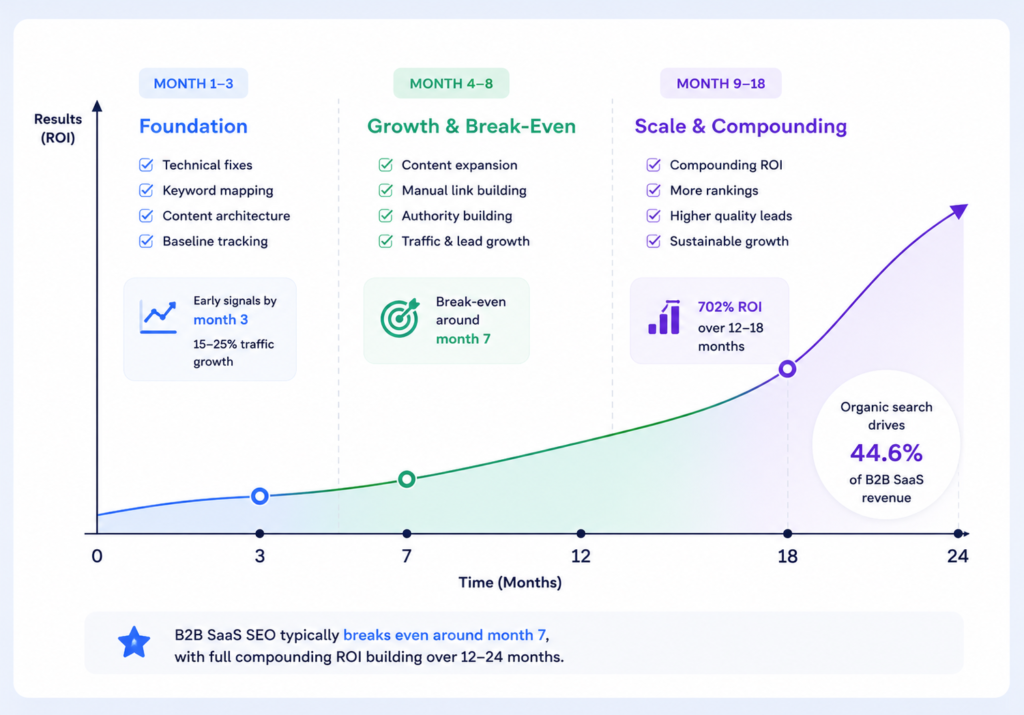
Organic search’s share of total revenue tends to be disproportionate to its cost at this stage. Industry data attributes roughly 44.6% of total B2B SaaS revenue to organic search — outperforming paid search and direct sales combined in several studies, largely because organic-sourced leads convert at meaningfully higher rates than paid traffic across most B2B categories.
What Actually Speeds This Timeline Up
A few factors reliably move the break-even point earlier, and they’re worth building into a plan deliberately rather than hoping for:
Domain authority already in place. High-authority domains can rank roughly 40% faster than low-authority ones for the same content — which is the core argument for prioritizing manual link building early rather than treating it as a later-stage tactic once content volume is already high.
Long-tail keyword targeting first. Content targeting long-tail terms sees traction roughly twice as fast as content chasing high-volume head terms — a sequencing decision, not a permanent strategy, since head terms become winnable once domain authority catches up.
Strong internal linking. Sites with deliberate internal linking structure cut time-to-rank by 20-25% compared to sites publishing disconnected pages with no topical relationship between them — the same logic covered in how to build a topical authority map.
Publishing consistency. Sites publishing 4+ pieces of content per month reach organic traffic milestones roughly 30% faster than less frequent publishers, according to aggregated 2026 SEO timeline data — consistency compounds the same way link building does.
What Slows It Down (or Stops It Entirely)
The most common failure isn’t a bad strategy — it’s abandoning a working one too early. Stopping after 3 months prevents the authority compounding that break-even depends on. Underinvestment has a similar effect: minimal budgets limit content depth and link acquisition frequency enough that the campaign never reaches the volume needed to compound. And setting a 30-day ROI expectation all but guarantees premature cancellation of a channel that was never going to move that fast by design — the same red flag covered in what to watch for when evaluating an SEO agency.
FAQ
Is 7 months really typical, or is that an optimistic average? It’s a genuine median across multiple independent studies (First Page Sage, SEMrush survey data, and cross-industry ROI reports), not a best-case number — though highly competitive niches like finance, legal, and enterprise SaaS commonly extend past 12 months before returns clearly outpace spend.
Does a bigger budget make this faster? Up to a point. Consistent, adequately-funded execution correlates with hitting breakeven on schedule, but doubling budget doesn’t halve the timeline — SEO compounds through accumulated authority and content volume over time, not through spend velocity alone.
What’s the fastest realistic win in month 1? Technical fixes. They don’t require new content or link building to show measurable ranking lifts, sometimes within 4 weeks, and they set the foundation everything published afterward builds on.
At Linqivo, campaigns are built around this exact timeline — technical foundation, consistent manual link building, and content sequencing designed to hit break-even on schedule rather than promising unrealistic 30-day results. See pricing plans or explore AI Visibility & GEO services if AI search is part of the growth plan too.