SEO & Link Building Agency Red Flags: How to Avoid Getting Scammed
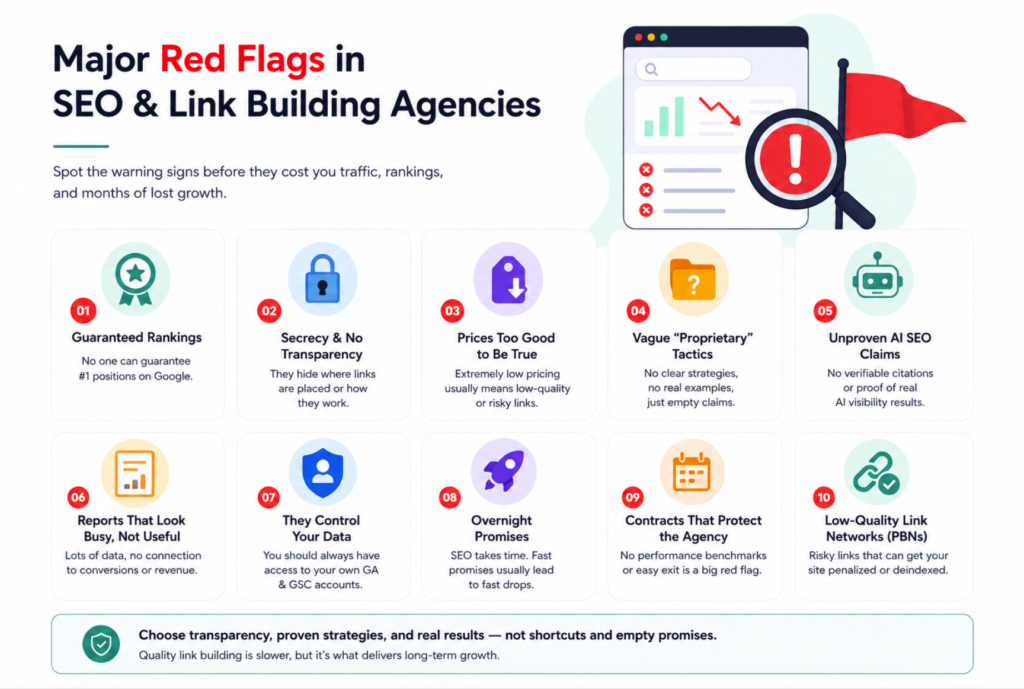
The clearest warning signs when evaluating an SEO or link building agency: guaranteed rankings, secrecy about which sites they’ll place links on, pricing far below the $5,000-$10,000/month range most professionals actually spend, vague “proprietary” tactics with no specific examples, and — increasingly in 2026 — AI SEO claims with zero verifiable citations to show for it. Any one of these alone is worth a direct question. Two or more together is a reason to walk away.
Why This Keeps Happening
Most businesses work with more than one SEO provider before finding a good fit. That’s an expensive education — not just the retainer paid, but the months of lost momentum, the links that need disavowing, and the hesitation that follows before investing in SEO again. The gap that lets bad agencies operate is simple: SEO still feels opaque to most buyers, and opacity is exactly what a bad actor needs to hide behind.
The Promise That Should Never Be Made
Google itself explicitly warns businesses to be wary of any SEO provider that guarantees specific rankings — no external party controls the algorithm, which makes a “guaranteed #1 spot” a promise no legitimate agency can actually keep. It’s one of the oldest red flags in the industry, and it’s still one of the most common, because it works on people who don’t yet know it’s impossible.
When the Price Doesn’t Add Up
Most SEO professionals report spending between $5,000 and $10,000 per month on link building specifically. When an offer lands at 100 links for $500, that’s not a deal — it’s a liability. Prices that low are only achievable through private blog networks or automated, low-quality placements, and Google’s systems are built specifically to detect that pattern. When a PBN network eventually gets identified and devalued, every site linking from it loses authority at the same time, including yours — so the risk isn’t isolated to the cheap links themselves, it spreads across everything they touched.
The Secrecy Problem
Legitimate link building involves real outreach, real content, and real relationship-building, which means a good agency should be able to name specific tactics and show specific examples rather than answering with something like “we have partnerships with hundreds of websites.” Refusing to share which domains links were placed on, or never providing visibility into link inventory and performance over time, is usually a sign there’s something to hide rather than nothing worth mentioning.
Reports That Say a Lot and Mean Little
A monthly report full of keyword impressions and generic traffic charts that never quite connects to conversions or revenue is designed to look busy, not to demonstrate results. If a report reads like a riddle rather than a clear line from work done to business impact, that disconnect is usually the point, not an accident.
The Newest Red Flag: Unproven AI SEO Claims
This one didn’t exist a few years ago and is now considered, across several 2026 industry analyses, the most dangerous red flag of the moment: an agency claiming AI SEO or AI Overview expertise without a single verifiable citation to show for it — for their own brand or for any client. AI visibility work is genuinely valuable right now, which is exactly what makes it attractive to claim without actually delivering. The simplest way to test this is asking directly to see one real example of a brand mention or citation the agency helped secure.
Who Actually Controls Your Data
Retaining direct access to your own Google Analytics and Search Console accounts matters more than it sounds. An agency that insists on controlling that access, or makes it inconvenient to get to, is quietly creating leverage to keep a client locked in regardless of whether the work is performing.
The Overnight Promise
SEO is a long-term channel by nature. Anyone promising significant ranking movement inside 30 days is either describing a technical fix — real, but that’s recovery from something broken, not SEO magic — or setting an expectation that collapses the moment the retainer clock actually starts. Rankings that spike quickly from purchased links tend to fall just as fast once a Google core update catches up to the pattern.
Contracts Built to Protect the Wrong Side
A long-term contract with no performance benchmark attached protects the agency, not the client. A provider confident in their own results generally has no problem tying retention to whether those results actually show up.
What Legitimate Link Building Actually Looks Like
The alternative to all of this isn’t complicated — it’s just slower, and it requires real work. Genuine placements come from earning coverage through valuable content, digital PR, industry partnerships, and manual relationship-building with real editors, not from a marketplace of interchangeable, low-traffic sites built solely to sell links. This is the same standard covered in how to choose a link building agency for SaaS and in white hat link building — transparency and real editorial relationships aren’t a nice-to-have, they’re the entire difference between a link that helps and one that eventually costs more to undo than it ever earned.
FAQ
If an agency won’t guarantee rankings, does that mean they’re not confident in their work? No — usually the opposite. A credible agency avoiding ranking guarantees is following Google’s own guidance, since no one outside Google controls the algorithm. Real confidence shows up in process transparency and past examples, not in impossible promises.
How much should link building actually cost per month? Most SEO professionals report spending $5,000-$10,000/month, though smaller SaaS companies can run effective campaigns well below that with a focused, transparent provider. The number to watch isn’t the price alone — it’s whether that price is realistic for manual, relevant outreach at all.
What should I do if I suspect my current agency is using PBN links? Ask for the full list of live URLs where links were placed, and check each one with a website authority checker for real organic traffic, not just a Domain Rating number. Thin content, random unrelated topics, and no visible traffic are the clearest signs of a link farm rather than a genuine placement.
At Linqivo, every placement is shared with the client before or immediately after it goes live — no black-box reporting, no guaranteed rankings, no pricing that only makes sense for automated links. See our pricing plans or check the best link building services comparison for how the market stacks up.