GEO Pricing: What Generative Engine Optimization Actually Costs in 2026
Generative Engine Optimization (GEO) — optimizing a brand to appear in AI-generated answers from ChatGPT, Perplexity, and Google’s AI Overviews — typically costs $1,500 to $10,000 per month for small and mid-sized businesses, with enterprise programs running $15,000-$50,000+. Ahrefs’ own research on AI Overview brand-visibility factors found branded web mentions correlate with AI citation far more strongly than raw backlinks — which is exactly why the entity and authority-building portion of a GEO budget matters more than the tracking dashboard most cheap packages lead with.
Why GEO Pricing Feels Chaotic
Ask five agencies what GEO costs and expect five different answers, ranging anywhere from a few hundred dollars a month to six figures. That’s not random — it reflects genuinely different things being sold under the same label. A $1,500/month package focused on reporting and content recommendations is not the same purchase as a $7,000 engagement that includes technical implementation, content production, entity optimization, and ongoing citation tracking. Comparing two GEO quotes on price alone, without checking what’s actually included, is the single most common mistake buyers make.
The Real Pricing Tiers
At the entry level, DIY tracking tools cost roughly $10-$1,000/month — these measure how often AI platforms mention a brand but do none of the actual optimization work. Entry-tier managed platforms that add basic visibility tracking and a handful of optimized articles monthly typically start around $200-$400/month for the tooling, scaling toward small-business retainers of $1,500-$5,000/month.
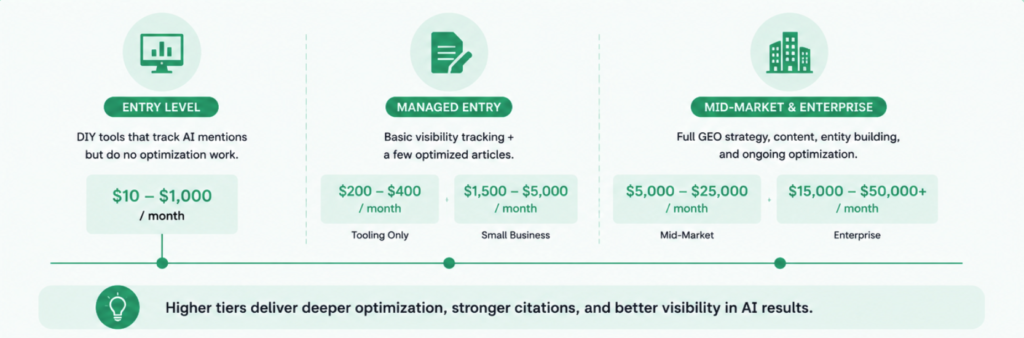
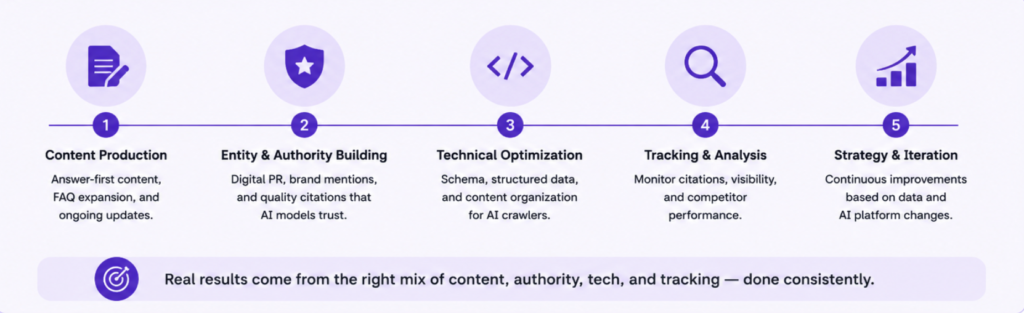
Mid-market agency retainers — the range most growing SaaS and service businesses actually land in — run $5,000 to $25,000 per month. This tier is where the real work happens: answer-format content rewrites, FAQ expansion, structured data implementation, and the entity/authority building that gives an AI model a reason to trust and cite a domain in the first place.
Enterprise programs covering multiple markets or a large existing content library commonly reach $15,000-$50,000+ per month.
What’s Actually Driving the Cost
Content production is usually the largest line item in a genuine mid-market retainer — rewriting existing content into answer-first formats and building new pages around the specific sub-questions AI engines surface, rather than the broader keywords traditional SEO vs AEO vs GEO work typically targets.
Entity and authority building is the layer that separates a basic “schema health check” package from a program that actually moves citation rates. This work — digital PR, structured citations on credible third-party sites, and consistent brand-mention signals — is directly connected to traditional link building too. The same outreach that earns a backlink increasingly earns an AI citation as well. It’s worth checking your own domain’s current standing with a website authority checker before committing to any retainer, so there’s a real baseline to measure progress against.
Technical schema and structured data implementation rounds out the cost — organizing content so AI crawlers can parse it cleanly.
Is the ROI Actually There?
Several 2026 industry reports cite AI-referred traffic converting significantly better than standard organic clicks — figures ranging from roughly 4x to over 20x lead-to-close rates appear across multiple agency reports. These numbers should be treated as vendor-reported claims rather than independently verified fact, since they come from firms selling GEO services. What’s less disputable: a growing share of high-intent research is happening inside AI chat interfaces, which is why our guide on how many backlinks you need to rank now factors AI citation potential into how we think about placement targets, not just classic referring-domain counts.
How to Evaluate a GEO Quote
The most useful question to ask any provider isn’t “how much” — it’s what specifically is included at that price. A legitimate mid-tier retainer should specify the number of content pieces produced monthly, which platforms get tracked, and whether competitive citation analysis is included. Any vendor work involved should also stay within Google’s Search Essentials guidelines — GEO tactics that lean on manipulative link patterns to force citations carry the same risk as any other spam approach, AI-facing or not.
FAQ
Is GEO a replacement for traditional SEO? No — the two should work together. GEO strengthens visibility in AI-generated answers specifically; traditional SEO still drives the classic organic rankings and traffic that AI visibility work builds on top of, a distinction covered in more depth in SaaS SEO strategy.
Do I need an ongoing GEO retainer, or can this be a one-time project? A one-time audit can address a specific gap, but ongoing visibility requires continued content production and monitoring, since competitors are also publishing and AI-generated answers shift as the content landscape changes.
What’s a reasonable starting budget for a small SaaS company? $1,500-$5,000/month is a realistic entry point for a small business, covering basic content optimization and visibility tracking without enterprise-scale authority building.
At Linqivo — an AI-ready link building agency built for SaaS — the same outreach and content that earns traditional backlinks also strengthens the entity signals AI platforms use to decide what to cite. See our white-label link building option if you’re an agency looking to resell this work.