Internal Linking Strategy: The Fastest Way to Improve Rankings Without New Backlinks
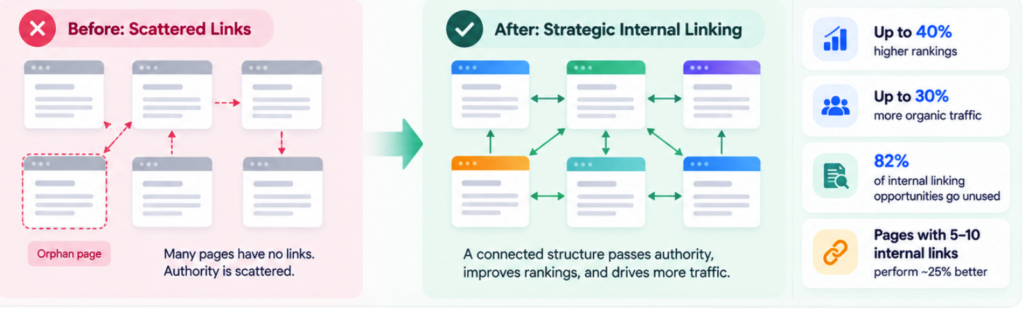
A structured internal linking strategy can improve rankings by up to 40% and organic traffic by 30% when built around topic clusters rather than scattered ad-hoc links — and it costs nothing beyond the time to implement it. Ahrefs’ own research found pages receiving 5-10 internal links perform roughly 25% better than pages with fewer connections, while a separate industry analysis found 82% of internal linking opportunities go completely unused across most sites. For a domain still building external authority, this is the highest-leverage lever available before the next backlink even arrives.
Why This Matters More Than It Sounds
Most sites treat internal linking as an afterthought — a navigation convenience, not a ranking lever. That’s a mistake with a real cost: roughly a quarter of pages on a typical site receive zero internal links at all, and fewer than half get enough to signal real importance to Google. Every one of those orphaned or under-linked pages is authority sitting unused, while a competitor building the same content with a deliberate linking structure captures the ranking that page could have earned.
The Data Behind Why This Works
Google reads internal link structure as a direct signal of what matters most on a site — which pages the site itself considers important, based on how often and how prominently they’re linked from elsewhere on the domain. Ahrefs’ analysis found pages with 5-10 internal links pointing to them rank meaningfully better than pages with fewer, and separate case study data from JetOctopus found a large site’s Googlebot crawl coverage jumped from 40% to 70% — a 30 percentage-point improvement — after a revised internal linking structure was implemented. Crawl coverage matters directly: a page Google never crawls thoroughly can’t rank well regardless of how good the content is.
The Model That Actually Works: Pillar and Cluster
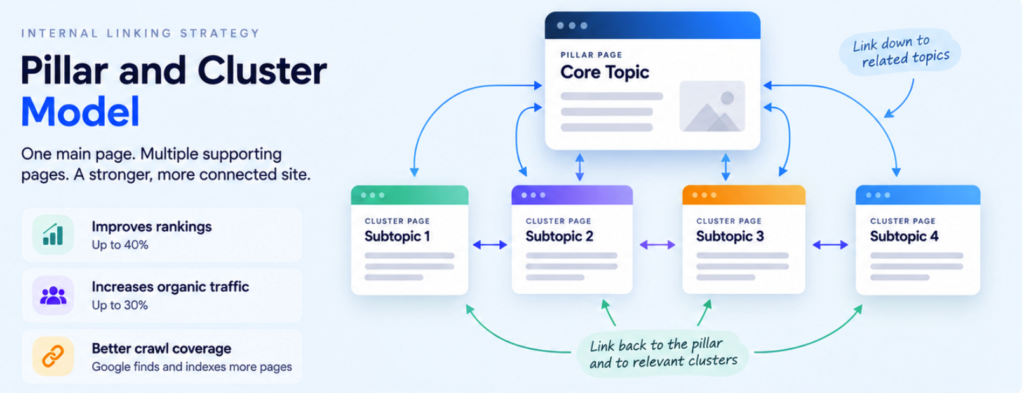
The dominant, proven architecture is pillar-cluster linking: one comprehensive pillar page covers a core topic broadly, and multiple narrower cluster posts each cover a specific sub-question, linking back up to the pillar and across to 2-3 related clusters. This is the exact structure covered in how to build a topical authority map — internal linking is the mechanism that actually implements a topical map once it’s been planned, not a separate step.
For a SaaS company specifically, that structure often looks like: connecting feature pages to relevant use cases and case studies, linking educational blog content toward product or service pages, and building resource hubs that aggregate everything related to one core topic rather than leaving posts to stand alone. A link building agency evaluating a client’s site for the first time checks exactly this — whether pages support each other internally, or whether every post is an isolated island competing for its own authority from zero.
How Many Links, and Where
The practical guidance across current data converges on 3-10 contextual internal links per 1,000 words for most content — enough to establish real topical connections without diluting the value of any single link. Anchor text distribution matters here too, following the same discipline covered in anchor text over-optimization: a small share of exact-match anchors, a larger share of partial-match descriptive phrases, and branded or generic anchors making up the rest. A natural-sounding internal link profile signals genuine content relationships; a profile stuffed with identical exact-match anchors reads as manipulation even internally.
The Mistake Most Sites Still Make
Random, ad-hoc linking — adding a link wherever one seems to fit in the moment, with no plan behind it — scatters authority instead of concentrating it. Every major ranking improvement documented across recent case studies traces back to reorganizing existing internal structure deliberately, not publishing new content or acquiring new links. That’s the part worth sitting with: a site can improve rankings meaningfully without touching its backlink profile at all, simply by fixing how its own pages already talk to each other.
A Practical Starting Process
Start by identifying orphan pages — content receiving zero internal links from anywhere else on the site — since these are the easiest, highest-ROI fixes available. Map existing content into logical pillar-and-cluster groups even if it wasn’t originally planned that way; most sites have more natural clusters already than they realize. Then work through each cluster systematically, adding contextual links where genuinely relevant rather than forcing connections between unrelated topics. This exact audit process is part of what a proper link audit should cover — internal structure alongside external link quality, since both affect the same ranking outcome.
Why This Matters for AI Search Too
Internal link structure isn’t just a classic-SEO concern anymore. Modern AI systems rely on link structures to understand topic relationships the same way Google’s crawlers do, which means a well-organized internal linking structure feeds both traditional rankings and AI-citation eligibility simultaneously — one more reason this work compounds rather than serving a single narrow purpose.
FAQ
Can internal linking really improve rankings without any new backlinks?
Yes — multiple 2026 industry analyses attribute ranking improvements of up to 40% to internal restructuring alone, since the authority already exists on the site and simply needed to be redirected toward the pages that matter most.
How often should an internal linking audit be repeated?
Regularly, not as a one-time project — new content creates new orphan pages and new cluster opportunities constantly, so a quarterly check catches drift before it accumulates.
Does internal linking help with anything beyond rankings?
Yes — it also reduces bounce rate and increases time on site by giving readers a clear path to related content, and it feeds the same topic-relationship signal AI search systems use when deciding what to cite.
What’s the fastest first step for a site that’s never done this deliberately?
Find and fix orphan pages first — content with zero internal links pointing to it is the highest-ROI, lowest-effort fix available, since any link at all is an improvement over none.
At Linqivo, internal linking is audited as part of every campaign — because a backlink pointing at a page with no internal support inside the site does less work than one landing inside a genuinely connected structure. See our pricing plans for the full breakdown.