Anchor Text Over-Optimization: How to Spot It and Fix It (2026)
Quick Answer: Anchor text over-optimization happens when too many backlinks use the same exact-match keyword phrase pointing at one page — a pattern Google’s Penguin system was built specifically to detect. Ahrefs analyzed 384,000 web pages and found that top-ranking pages average close to zero exact-match anchors; the pages that rank on page 1 got there through a natural, varied anchor mix, not keyword stuffing. The fix isn’t avoiding exact-match anchors entirely — it’s keeping them under roughly 5% of your total profile while branded and partial-match anchors do the heavy lifting.
What Over-Optimization Actually Looks Like
Over-optimization isn’t about any single link. It’s a pattern across your whole backlink profile. If ten different websites all link to your pricing page using the exact phrase “link building services usa,” that’s not ten separate signals of relevance — it’s one obvious signal of manipulation, because real editors linking naturally almost never converge on identical wording.
Google’s Penguin update has been part of the core algorithm since September 2016 specifically to catch this pattern in real time. The mechanism hasn’t gone away in 2026 — it’s just gotten quieter. Rather than triggering a visible manual action, over-optimized links today are more likely to simply get devalued: Google’s systems recognize the manipulation and discount those links rather than counting them at all. Either way, the practical effect is the same — money spent building those links produces little to no ranking benefit.
What the Data Actually Shows
This is the part most guides skip entirely: real numbers, not just warnings. Ahrefs’ analysis of 384,000 web pages found that the mean exact-match anchor percentage among top-ranking pages sits close to zero — pages don’t reach page 1 by stuffing keyword anchors, they get there through a diverse, natural-looking distribution.
Separately, agency-reported data puts the danger threshold at roughly 8% exact-match anchors on commercial keywords — ratios above that correlate with ranking drops within one to three months. Industry-wide, top-ranking pages average around 13% exact-match anchors according to Ahrefs’ 2025 data, though that figure varies significantly by niche and mostly reflects a mix of aged, established domains rather than a target for a newer site to aim at directly.
The safest practical benchmark for most sites, especially newer or lower-authority domains: keep exact-match anchors under 5% of the total backlink profile. This is more conservative than the industry average on purpose — a newer domain has less accumulated trust to absorb an aggressive anchor pattern than an established one does.
The 5 Anchor Types and How to Balance Them
| Anchor Type | Example | Safe Usage |
|---|---|---|
| Branded | “Linqivo” | Should dominate — 40-60% of profile |
| Naked URL | “linqivo.com” | Natural, low-risk — 10-20% |
| Generic | “click here”, “this guide” | Natural, low-risk — 10-15% |
| Partial match | “affordable link building options” | Safe workhorse — 15-25% |
| Exact match | “link building services” | High-risk — keep under 5% |
The goal isn’t avoiding exact-match anchors — it’s making sure they’re the smallest slice of a much larger, more natural mix. This is the same discipline behind white hat link building done properly: the anchor text is a byproduct of genuine outreach, not something engineered link by link.
Internal Links Play by Different Rules
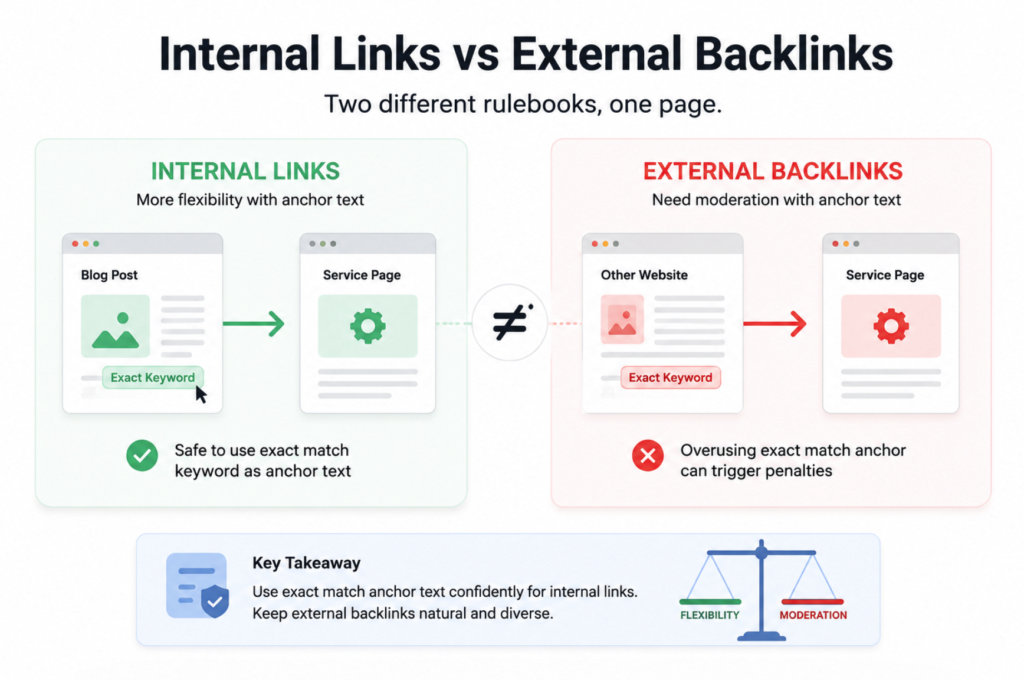
This distinction gets missed constantly. Internal links tolerate far more keyword-rich anchor text than external backlinks — Google has confirmed there’s no meaningful internal-linking-anchor penalty the way there is for external links. That means a blog post can safely link to a service page using its exact target keyword as anchor text internally, even while that same phrase needs to stay rare across external backlinks pointing at the same page. Two different rulebooks, one page.
How to Audit Your Own Anchor Profile
- Export your full backlink list using a website authority checker or similar tool. Pull every referring domain and its anchor text into one sheet.
- Tag every anchor by type. Branded, naked URL, generic, partial match, or exact match — one column, one row per link.
- Calculate the exact-match percentage per landing page, not just site-wide. A page can look fine in aggregate while one specific URL is dangerously over-optimized.
- Compare against the top 3 ranking pages for your target keyword. Pull their anchor distribution with the same tool and use it as your benchmark — competitive context matters more than a generic industry rule.
- Flag anything above 8% exact-match on a commercial, revenue-driving page for review.
Quick Reference: Signals to Watch
| Signal | Safe Range | Red Flag |
|---|---|---|
| Exact-match anchors | Under 5% | Above 8% on a commercial page |
| Branded anchors | 40%+ | Under 20% |
| Anchor repetition | No single phrase over 10-15% of links | Same exact phrase across 30%+ of links |
| New links this month | Mix of anchor types | All new links using the same exact-match anchor |
Fixing an Already Over-Optimized Profile
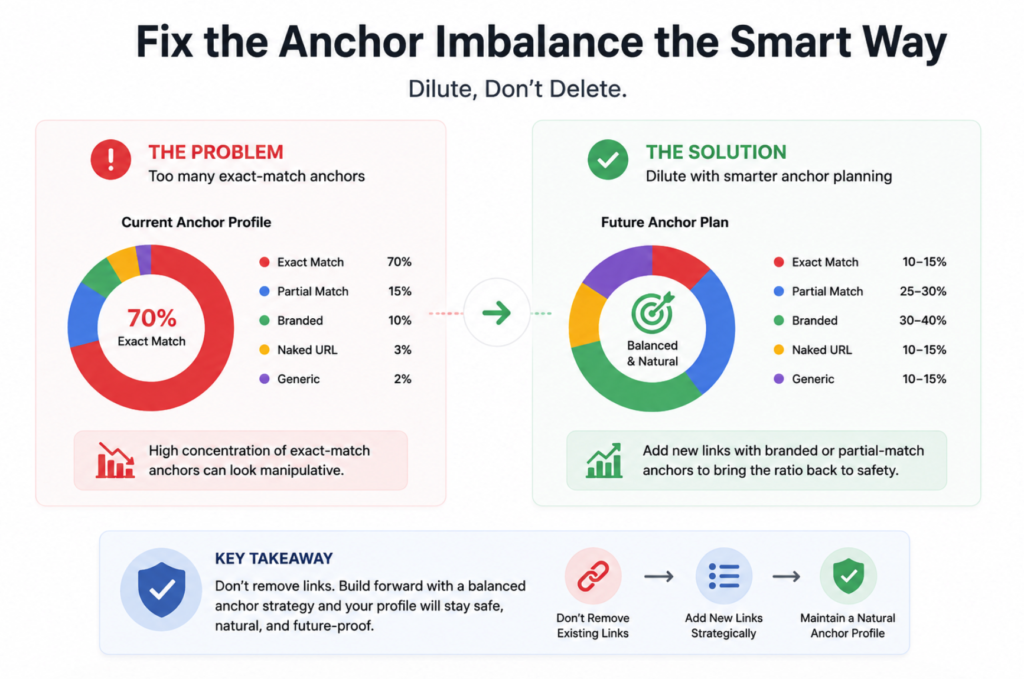
If an audit turns up a dangerous concentration of exact-match anchors, the fix isn’t removing existing links — in most cases that’s neither realistic nor necessary. The better approach is diluting the pattern going forward: every new link added should deliberately skew branded or partial-match until the ratio comes back into a safer range. This is exactly the kind of anchor planning built into SaaS link building — rotating anchor types campaign to campaign so the profile never drifts toward a detectable pattern in the first place.
A related, ongoing check worth building into the process: a periodic link audit that looks at anchor distribution alongside link quality and relevance — the same review that catches spammy placements tends to catch anchor drift before it becomes a real risk.
Why This Matters for AI Search Too
AI systems like ChatGPT, Perplexity, and Google’s AI Overviews don’t weight anchor text the way Google’s core ranking algorithm does — they rely on semantic retrieval, so the words surrounding a link often matter more than the anchor text itself. But the underlying discipline still applies: content and links that read naturally, without engineered keyword patterns, build the kind of clear entity signal that both classic rankings and AI citation systems reward. The anchor strategy that protects a site from a Google penalty and the one that earns AI citations aren’t in tension — they’re the same strategy.
Common Mistakes
- Auditing anchor ratios site-wide instead of per landing page, which hides dangerous concentration on individual money pages.
- Applying the same exact-match limit to internal links as external ones — internal links follow different, more forgiving rules.
- Using a single generic industry ratio instead of benchmarking against the actual top 3 competitors for a target keyword.
- Treating a devalued link the same as a penalty — devaluation is silent and easy to miss without a proper audit.
- Removing large numbers of existing links reactively instead of diluting the ratio gradually with new, varied anchors.
FAQ
Will one exact-match anchor get my site penalized? No — Google doesn’t penalize individual anchors, it penalizes patterns. A single exact-match link from a genuinely relevant, high-authority site is normal and safe; the risk comes from many links converging on the identical phrase.
Is a manual action still a real risk in 2026? Less than it used to be. The more common outcome now is quiet devaluation — Google’s systems identify the manipulative pattern and simply discount those links rather than issuing a visible manual action. The financial effect for a business is similar either way: money spent on those links produces little ranking value.
What’s the safest exact-match anchor percentage for a newer site? Under 5% is the conservative, safe benchmark for most sites, particularly newer or lower-authority domains that haven’t built up enough overall trust to absorb an aggressive pattern.
At Linqivo, every campaign plans anchor distribution before outreach starts, not after — branded and partial-match anchors doing most of the work, exact-match used sparingly and only on genuinely relevant, high-authority placements. See pricing plans or the full link building strategies guide for more.