How to Vet a Link Building Agency’s Backlink Samples (Quality Checklist)
Quick Answer: Before paying for any placement, check five things on the actual sample: real organic traffic at the page level (not just domain-wide DR), topical relevance to the specific article the link sits in, the host site’s outbound link patterns, referring domain history for signs of manipulation, and whether the content itself reads as genuinely written, not spun or AI-filler. A site that passes only the DR filter isn’t a quality placement — all five checks need to clear before a link is worth paying for.
Why DR Alone Keeps Fooling Buyers
Domain Rating and Domain Authority are useful starting filters, but they’re not enough on their own — and vendors know it. A site with DR 75 can still be a terrible link source if that authority comes from a manipulated backlink profile, if its traffic is fake, if its content is AI-spam, or if it sells links to anyone with a credit card. Vendors who sell purely on DR are gaming the single easiest variable to fake. The metrics that actually predict whether a link helps — real traffic, topical relevance, editorial standards — are messier to verify, which is exactly why so few buyers check them.
The Five-Point Check Before Any Placement
1. Real organic traffic, at the page level. Domain-wide traffic numbers hide a lot. A DR 70 site with 200 monthly organic visits total is effectively a graveyard — check traffic specifically to the page where the link will sit, using a website authority checker or similar tool, not domain-wide averages.
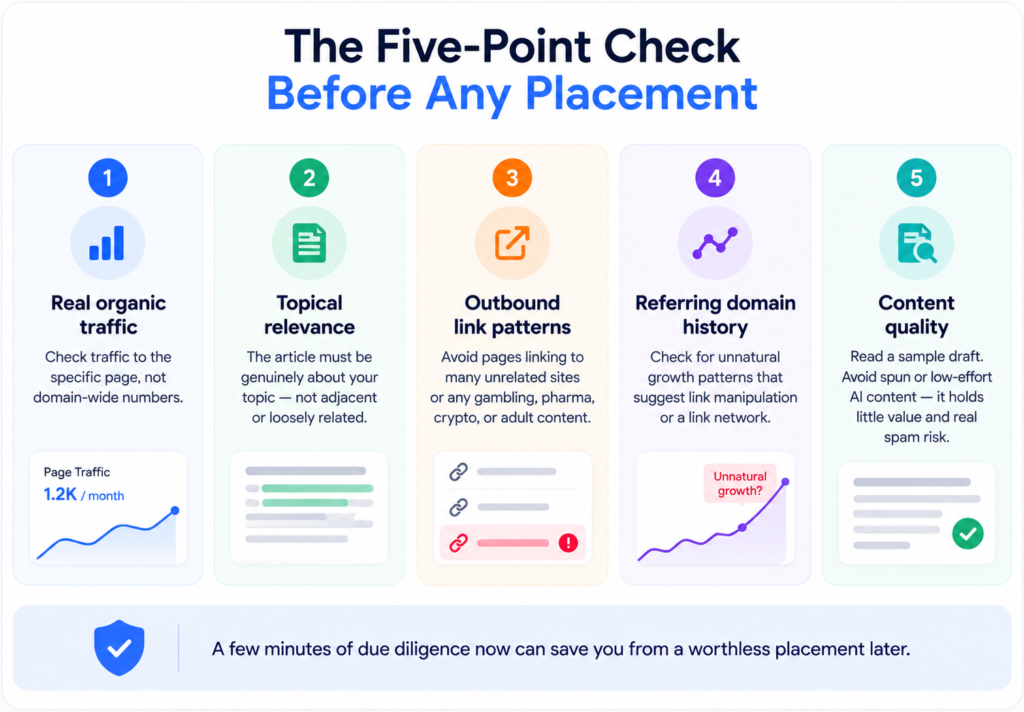
2. Topical relevance to the specific article, not the broad industry. A general “marketing” site is not as relevant as a site that specifically covers a client’s exact category. The article the link sits inside needs to be genuinely about the topic — not adjacent to it, not loosely related.
3. Outbound link patterns on that specific page. If the host page already links out to 20-30 unrelated commercial sites, or shows a pattern of gambling, pharma, crypto, or adult-content links elsewhere on the site, that’s a clear signal of a link-selling operation rather than genuine editorial content.
4. Referring domain history for manipulation signals. Check the site’s own backlink profile for an unnaturally exponential growth curve in referring domains — a pattern common among link networks built specifically to sell placements rather than sites that earned authority organically over time.
5. Content quality, read manually. Ask for an unplaced sample draft and actually read it. Spun content or unedited AI-generated filler carries close to zero authority value regardless of what site it sits on — and increasingly carries real spam risk as Google’s spam policies get better at detecting low-effort content patterns.
Red Flags Worth Ending the Conversation
A few phrases and patterns are reliable warning signs on their own. “All our links are DR 50+ because that’s what Google values” misunderstands the metric entirely — Domain Rating is an Ahrefs measurement, not a Google ranking factor, and relevance plus real traffic matter far more than a single third-party score. Any guarantee of specific rankings is either genuine inexperience or a sales tactic, since no vendor controls Google’s algorithm. And a pre-curated list of sites offered before any conversation about the client’s actual niche usually means the same generic inventory gets sold to every buyer, regardless of fit.
What a Realistic Vetting Process Looks Like
Plan for one to two weeks if being thorough. That’s enough time to request sample placements, run domain audits, verify traffic claims independently rather than trusting a screenshot, check sample content for originality, and compare against at least one other vendor. Traffic proof specifically should come from Google Analytics or Search Console data shared directly — a static screenshot is trivial to fabricate and shouldn’t be accepted as verification on its own.
The Pricing Signal Worth Knowing
Clean, properly vetted placements with original content typically run $300-$700 per link in mid-tier B2B niches, and $700-$1,500+ in more competitive verticals like finance, legal, and SaaS specifically. Anything significantly below that range is almost always cutting a corner somewhere — usually traffic verification or content quality. That doesn’t mean the most expensive option is automatically the best, but a suspiciously cheap price is reliably a warning sign, the same pattern covered in SEO agency red flags.
The Warning Sign After Placements Start
The earliest signal something’s wrong isn’t always an obvious spam pattern — often it’s simply a flatline. Links get placed on schedule, delivery looks consistent, and nothing moves in rankings, because Google’s systems have quietly decided the links don’t count. That’s the soft signal worth watching for: a steady delivery cadence with zero corresponding movement, which is worth checking against a proper link audit rather than assuming the campaign just needs more time.
FAQ
Is it reasonable to ask an agency for sample placements before signing? Yes — legitimate providers routinely share case studies and live URL examples from comparable campaigns. An agency reluctant to show any real placement history before payment is itself a red flag.
How often should an existing backlink profile be audited, not just new placements? Quarterly is a reasonable baseline for most sites; monthly makes sense in more competitive niches, since spammy links can accumulate from a bad vendor relationship without becoming obvious for months.
What’s the fastest way to check if a placement site’s traffic claims are real? Request direct access to Google Analytics or Search Console data for the specific page, not a screenshot — and cross-check organic keyword rankings independently through Ahrefs or Semrush rather than trusting the number as given.
Does a high price guarantee a quality placement? No — expensive doesn’t automatically mean good, but the five-point check still applies regardless of price. A high price without real traffic, relevance, and clean content is just an expensive version of the same problem.
At Linqivo, every placement passes this exact standard before it’s ever offered — real traffic verified, topical relevance checked by actually reading the page, and live URLs shared so nothing is taken on trust. See our pricing plans or the best link building services comparison for how the market stacks up.