How to Measure SEO & Link Building ROI for SaaS (Metrics Your CEO Actually Cares About)
Traffic and rankings don’t survive a board meeting. The metrics that do: Organic Pipeline Contribution, Organic CAC versus Paid CAC, LTV:CAC ratio, and — increasingly in 2026 — AI Citation Share of Voice. High-performing B2B SaaS companies see organic CAC payback in 5-7 months, with a median around 6.8 months, well ahead of most paid channels. If a report can’t connect a specific number back to pipeline or revenue, it’s measuring activity, not impact.
Why Traffic Charts Lose Budget Battles
Most SaaS marketing leaders lose the argument for continued SEO investment for one specific reason: they report on traffic instead of revenue. A chart showing organic sessions climbing looks good in isolation, but it answers a question no CFO actually asked. The question that matters is whether that traffic turns into pipeline, and whether it does so more efficiently than the channels currently getting the budget.
This gap gets wider with AI search in the mix. With a large share of B2B buyers now using AI tools during vendor research, a measurement framework built only around clicks and last-touch attribution misses a growing share of where buying decisions actually form — the “dark funnel” effect, where prospects research heavily before ever converting on a tracked page.
The Four Metrics That Actually Matter
1. Organic Pipeline Contribution. Not sessions, not rankings — the dollar value of pipeline that can be traced back to organic-sourced touchpoints. This requires mapping UTM parameters or source data into CRM custom fields early enough that a lead’s original channel doesn’t get overwritten as it moves through pipeline stages. Without this step, organic-sourced deals silently get credited to whatever channel touched them last.
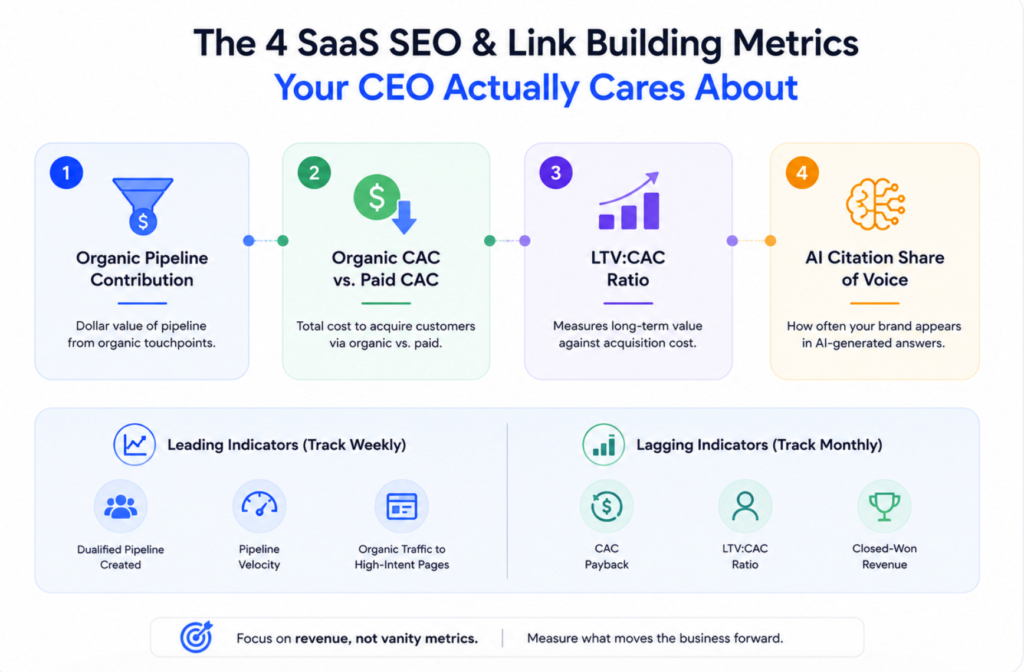
2. Organic CAC vs. Paid CAC. Total SEO and content investment divided by new customers acquired through that channel, set directly against the same calculation for paid acquisition. The case for continued investment becomes concrete the moment organic CAC comes in meaningfully lower than paid — even after accounting for the slower ramp period organic channels require compared to a paid campaign that starts producing leads immediately.
3. LTV:CAC Ratio. CAC alone is meaningless without knowing what a customer is actually worth over their lifetime. A 3:1 ratio is the baseline for sustainable B2B SaaS growth; anything below that means the business is essentially trading dollars rather than compounding them. This ratio matters specifically for SEO-attributed customers because organic-acquired customers frequently show different retention patterns than paid-acquired ones — a distinction worth tracking separately rather than blending into a single blended CAC number.
4. AI Citation Share of Voice. The newest addition to this list, and the one most agencies still aren’t tracking. When a buyer asks ChatGPT or Perplexity “what’s the best [category] tool,” not appearing in that answer is a real measurement failure, not a minor gap — since a growing share of vendor research now happens inside those conversations before a prospect ever runs a traditional Google search. This is covered in more depth in checking brand visibility in ChatGPT, and it’s exactly the gap AI Visibility & GEO work is built to close.
CAC Payback: The Number That Wins Board Meetings
High-performing B2B SaaS companies achieve an organic CAC payback period of 5-7 months, with the category median sitting around 6.8 months — a number that holds up well against most paid acquisition channels once the full ramp period is factored in. This connects directly to the timeline covered in how long SaaS SEO takes to show ROI: the payback period and the break-even point are measuring closely related things, just from slightly different angles — one tracks cost recovery per customer, the other tracks when cumulative investment turns net-positive.
Leading Indicators vs. Lagging Indicators
A useful reporting dashboard separates what’s tracked weekly from what’s tracked monthly. Leading indicators — qualified pipeline created, pipeline velocity, organic traffic to high-intent pages like pricing and comparison content — move fast enough to review weekly and catch problems before they hit a quarterly number. Lagging indicators — CAC payback, LTV:CAC ratio, closed-won attributed revenue — confirm whether the leading indicators actually translated into results, and belong in a monthly or quarterly review rather than a weekly check-in.
Pipeline velocity itself is worth calculating directly: qualified opportunities multiplied by win rate multiplied by average deal size, divided by sales cycle length in days. Tracked weekly, it gives an early read on whether a quarter’s revenue target is still realistic before the pipeline has time to age out.
Why Blended CAC Hides the Real Story
A single blended CAC number across all channels flattens exactly the comparison a CEO needs to see. Organic and paid acquisition typically show different cost structures, different ramp times, and often different retention behavior once a customer is acquired. Reporting organic CAC and paid CAC side by side — rather than folding them into one number — is what actually makes the case for reallocating budget, since it’s the comparison, not the absolute figure, that changes minds in a budget conversation.
What This Looks Like on High-Intent Pages Specifically
Not all organic traffic carries equal weight. Traffic landing on pricing, feature comparison, and alternatives pages signals a buyer meaningfully further along than traffic landing on a top-of-funnel blog post — which is exactly why link building for SaaS should prioritize authority-building toward those specific pages rather than spreading link equity evenly across a site. A report that separates high-intent-page traffic from general blog traffic tells a much more useful story than a single aggregate traffic number ever could.
FAQ
How do I start attributing organic traffic to actual revenue if I’ve never tracked this before? Start by mapping UTM parameters and source data into custom CRM fields immediately — even a few months of consistent tracking going forward is more useful than trying to reconstruct historical attribution after the fact.
What’s a realistic LTV:CAC ratio for an early-stage SaaS company? Early-stage companies under a few million in ARR often see ratios closer to 2.5:1 with longer payback periods; the 3:1 baseline and faster payback windows tend to appear once a company reaches growth stage and acquisition channels mature.
Is AI Citation Share of Voice really worth tracking yet, given how new AI search still is? Yes — with a majority of B2B buyers now using AI tools somewhere in their research process, a brand invisible in those answers is invisible at exactly the research stage that increasingly determines the shortlist, regardless of how new the measurement category itself is.
At Linqivo, reporting is built around pipeline and revenue-linked metrics rather than traffic charts — the same discipline covered on our pricing page and across every link building engagement we run.