Link Building vs Digital PR: Which Should Your SaaS Choose?
Quick Answer: Neither replaces the other — they solve different problems. Link building gives you control over exactly which pages get authority and what anchor text they use, making it the right tool for a specific pricing or comparison page that needs to rank now. Digital PR earns higher-authority placements and the brand mentions AI models cite most, but you can’t choose which page a journalist links to or when a story lands. Most SaaS companies growing past $1M ARR eventually need both — the question is which to prioritize first given a limited budget.
The Pain Point Behind This Question
Almost every SaaS founder asking this has the same underlying frustration: they’ve spent money on one tactic, seen mixed results, and are trying to figure out if the problem was the tactic or the execution. It’s rarely either in isolation — it’s usually a mismatch between the tactic and the goal. Link building aimed at a page that needs authority right now works differently than PR aimed at building brand-wide recognition over months. Confusing the two is the single most common reason a budget feels wasted even when the work itself was done competently.
What Link Building Actually Controls
Manual link building — guest posts, niche edits, resource page placements — gives a marketer direct control over which page receives a link and what anchor text points to it. That control matters enormously for revenue-driving pages: a pricing page, a comparison page, or a specific integration page that needs to outrank a named competitor for a specific keyword. Link building strategy built around targeting these exact pages is how a SaaS company moves a specific ranking, on a specific timeline, rather than waiting for broad brand authority to eventually trickle down.
The tradeoff is authority ceiling. Most manual link building placements land in the DR 20-60 range — solid, relevant, but rarely the DR 70+ editorial placements a national publication provides.
What Digital PR Actually Controls
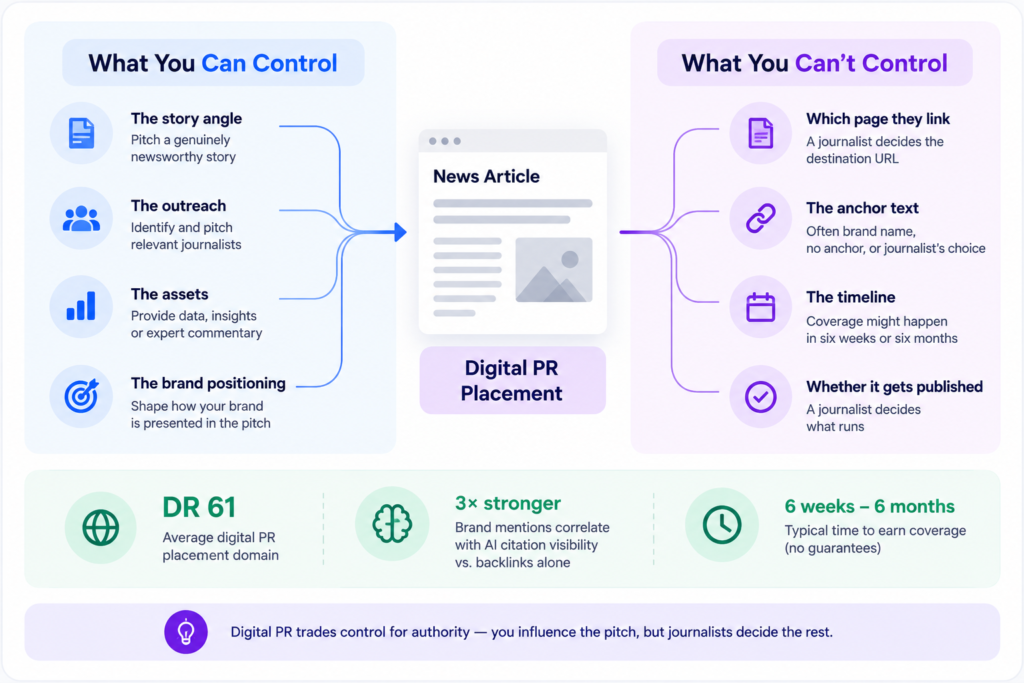
Digital PR earns coverage because a story is genuinely newsworthy, which means a brand can influence the pitch but not the outcome. A journalist decides which page to link, what anchor text to use (often none, or the brand name), and when the story runs. In exchange, the average digital PR placement lands on a DR 61 domain — authority no amount of guest post outreach reliably reaches — and it produces exactly the kind of brand mention Ahrefs’ research found correlates roughly three times more strongly with AI citation visibility than backlinks alone, per Ahrefs’ 75,000-brand study.
The tradeoff is control and timeline. A data study might earn coverage in six weeks or six months, and there’s no guaranteeing which specific page benefits.
Side by Side
| Link Building | Digital PR | |
|---|---|---|
| Page targeting | Full control | No control — journalist decides |
| Anchor text | Planned, varied | Usually brand name or none |
| Typical authority | DR 20-60 | DR 61 average, often 70+ |
| Timeline | Weeks | 3-6 months typically |
| AI citation strength | Moderate | Strong — earned media drives 84% of AI citations |
| Best for | Specific revenue pages | Brand-wide authority and AI visibility |
The Real-World Answer: Sequence, Don’t Choose
The most functional pattern for a growing SaaS company isn’t picking one — it’s sequencing both against the actual budget available. Early-stage companies with limited budget generally get more immediate return from targeted link building on revenue pages, since that’s where a ranking improvement translates directly into pipeline. Once core pages are ranking competitively, digital PR becomes the higher-leverage next investment — it builds the brand-wide authority and AI-citation signal that a purely page-targeted strategy can’t reach on its own.
This mirrors the same discipline covered in how to measure SEO and link building ROI for SaaS: pipeline-driving pages get link building’s precision first, brand-wide visibility gets PR’s authority once there’s budget to sustain a 3-6 month campaign.
Where Founders Actually Get Stuck
The recurring pain point isn’t picking wrong — it’s abandoning a tactic before it had time to work. A link building campaign stopped after six weeks because “nothing moved” was likely never given enough time to compound. A digital PR campaign judged a failure after one pitch cycle was likely never given the 3-6 month runway 85% of successful campaigns actually need. Both tactics fail the same way: judged on a timeline shorter than either was ever built to deliver on.
FAQ
Which should a pre-revenue or very early-stage SaaS company start with? Link building, generally — it’s faster to see movement on, cheaper per placement, and doesn’t require the product usage data most digital PR data studies rely on.
Is it a waste to run both at the same time? Not if budget allows — many companies run consistent monthly link building on revenue pages while a slower-moving digital PR campaign builds toward a future placement, rather than treating them as sequential phases.
Does digital PR help with anything link building can’t? Yes — specifically, AI citation visibility. Since earned media accounts for 84% of AI citations versus 0.3% for paid content, digital PR is structurally suited to a goal link building alone can’t fully reach.
How do I know if my current campaign just needs more time versus actually not working? Check the timeline against the tactic — link building should show early signals within 6-12 weeks; digital PR needs 3-6 months before judging results, per industry-wide campaign data.
At Linqivo, both tactics are built around the same standard — real relevance, no PBNs, and reporting that shows exactly what moved. See our pricing plans or explore SaaS link building services to see how the two work together.