What Is a Topical Authority Map? A Practical SEO Guide (2026)
Q: What is a topical authority map? A: A topical authority map is a structured plan that organizes your website’s content around one core subject and its related subtopics, showing search engines and AI systems that you cover a topic in depth rather than publishing scattered, disconnected posts. It’s the difference between having 50 blog posts that compete with each other and having 50 posts that each reinforce the same core expertise.
Why Most Content Doesn’t Build Authority
Most sites publish the way a to-do list gets written — whatever keyword idea comes up next. The result is a blog with dozens of posts that never connect to each other, each one starting from zero in Google’s eyes. No single post benefits from the others existing.
A topical authority map fixes that by deciding, before you write anything, what the site is actually going to be known for. Every new post either strengthens that core subject or it doesn’t get written. Search engines reward this kind of structure because it mirrors how Google’s own documentation on link best practices describes healthy site architecture — content and links that reinforce a coherent subject, not isolated pages competing with nothing to support them.
At Linqivo, this is the same principle we apply to link building itself: a link only earns its full value when it points to a page that sits inside real topical structure, not a random standalone post.
The Three Layers of a Topical Map
1. The core entity. This is the one subject your site is fundamentally about — for a link building agency, that’s link building and SEO authority, not “digital marketing” broadly. Being specific here is what makes the rest of the map work.
2. Pillar topics. The major subtopics that fall under your core entity. For link building, that’s things like: link building tactics, link building pricing, link building tools, agency selection, and AI search visibility. Each pillar deserves one strong, comprehensive page.
3. Cluster content. The specific, narrower articles that support each pillar — the how-tos, comparisons, and deep dives that answer one precise question each. A pillar on “link building strategies” might branch into cluster posts on the best backlinks for SEO, guest posting, and how many backlinks you actually need to rank.
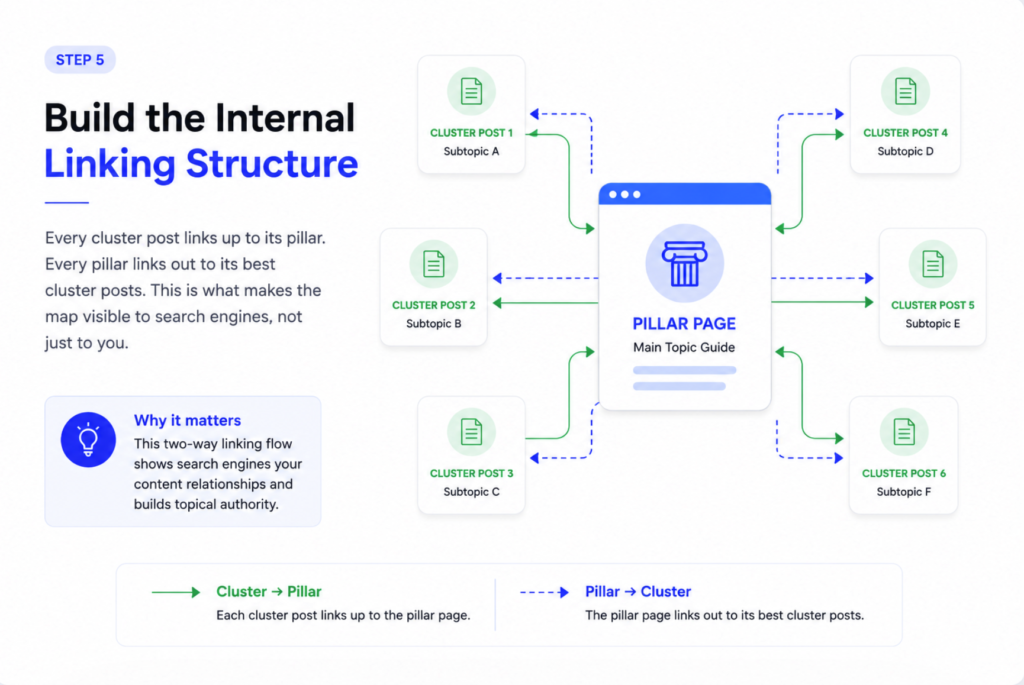
The pillar and its clusters link to each other deliberately — clusters link up to the pillar, and the pillar links out to relevant clusters. That internal linking structure is what turns a pile of blog posts into a map Google can actually read as expertise.
Why This Matters More in 2026
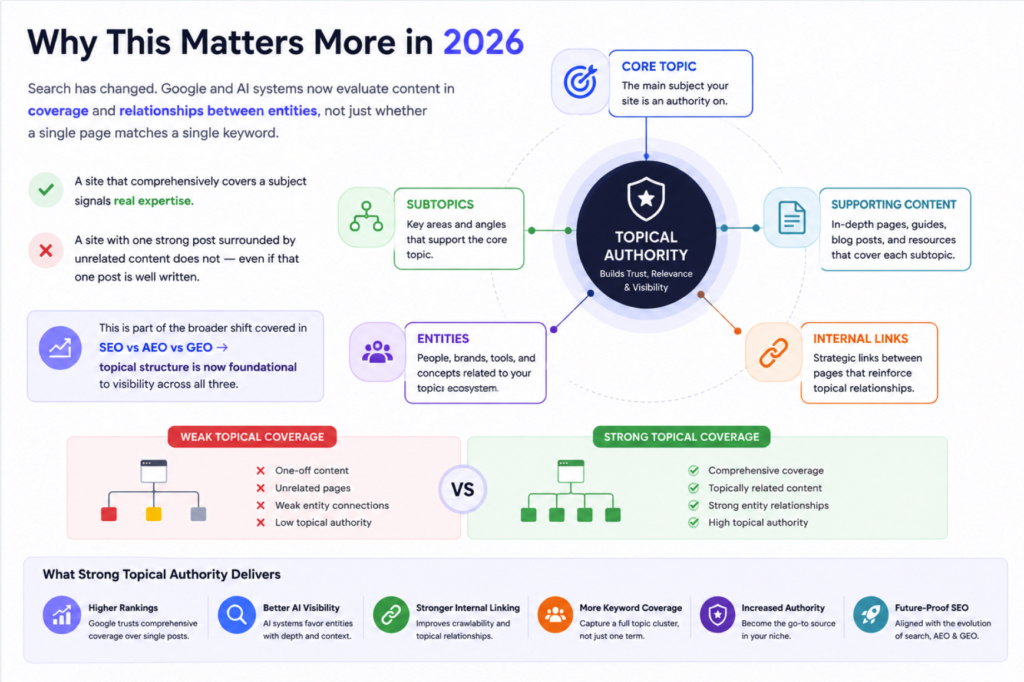
Search has changed in a specific way: Google and AI systems increasingly evaluate content in terms of coverage and relationships between entities, not just whether a single page matches a single keyword. A site that comprehensively covers a subject signals real expertise; a site with one strong post surrounded by unrelated content does not — even if that one post is well written. This is part of the broader shift covered in SEO vs AEO vs GEO — topical structure is now foundational to visibility across all three.
This connects directly to link building too, and it’s the part most topical-authority guides skip entirely: external links reinforce topical authority the same way internal links do. A backlink pointing to a page that sits inside a coherent topic cluster carries more weight than the same link pointing to an isolated, unrelated page — because the surrounding content gives Google more context for what that page, and by extension your entire site, is actually an authority on. That’s part of why a quick check with a website authority checker on your own domain often reveals that your strongest-ranking pages are the ones sitting inside a real content cluster, not standalone posts with no supporting structure around them.
How to Build Your Own Topical Map
Step 1: Define your core entity precisely. Write one sentence describing exactly what your site is an authority on. Vague answers produce vague maps.
Step 2: List your pillar topics. Aim for 4–8 major subtopics that fully cover your core entity. If you can’t explain why a pillar belongs, it probably doesn’t.
Step 3: Audit what you already have. Go through your existing content and sort each piece under a pillar. Anything that doesn’t fit under any pillar is either cut, rewritten, or merged. This is the same discipline behind guest posting for AI visibility — content with no real home in your site’s structure tends to lose value over time regardless of how well it was written.
Step 4: Find the gaps. For each pillar, list the specific questions a genuinely knowledgeable person on that subject would be expected to answer. Missing answers are your content gaps. A quick authority comparison against competitors ranking for your pillar topics is a fast way to spot what they’re covering that you aren’t.
Step 5: Build the internal linking structure. Every cluster post links up to its pillar. Every pillar links out to its best cluster posts. This is what makes the map visible to search engines, not just to you.
Step 6: Point new links at the map, not just the homepage. As you build authority through outreach, direct that authority toward pillar and cluster pages already inside your topic structure. Genuine, editorially placed links — the kind that follow Google’s spam policies rather than trying to game them — do far more for a page that’s already part of a real cluster than for an isolated page with nothing supporting it.
What Happens If You Skip This
Sites without a topical map tend to show a familiar pattern: individual posts that briefly rank, then slide as competitors with more comprehensive coverage overtake them. Ahrefs’ own link rot study found that a large share of backlinks stop pointing anywhere useful within a few years — and the same erosion happens to authority signals on pages that were never reinforced by a broader content structure in the first place. A topical map doesn’t just help you rank faster; it’s what keeps the ranking from quietly decaying once competitors catch up.
Common Mistakes
- Chasing a new keyword every week instead of asking whether it fits an existing pillar.
- Building a topical map with no internal linking to back it up — the structure exists on paper but nowhere on the actual site.
- Treating “topical authority” as a content-only exercise and ignoring that external links reinforce the same signal internal links do.
- Making pillars too broad (“SEO”) or too narrow (a single long-tail keyword) instead of a genuinely useful middle layer.
- Never revisiting the map — a topical map from a year ago that hasn’t absorbed new pillars or retired outdated clusters stops reflecting what the site actually covers.
FAQ
Q: How is a topical map different from a keyword list?
A: A keyword list is just a set of search terms to target individually. A topical map organizes those terms around entity relationships and content structure — it prioritizes how topics connect to each other over raw search volume, which is why it holds up better as search evolves toward evaluating expertise rather than isolated matches.
Q: How long does it take to see results from building topical authority?
A: There’s no fixed timeline, but the pattern is consistent: individual posts within a well-structured topic cluster tend to rank faster and hold their positions better than isolated posts, because they’re supported by internal links and surrounding context rather than competing alone.
Q: Do backlinks still matter if I have strong topical authority?
A: Yes — they work together, not as substitutes for each other. A topical map without external validation is still just your own claim to expertise; backlinks are what confirm that claim from outside your own site. This is why link building strategy and topical structure need to be built in parallel, not in sequence.
Q: Should I hire an agency to build my topical map, or do it myself?
A: Either can work, but the risk with agencies is the same one covered in our comparison of Linqivo vs. FatJoe and Linqivo vs. uSERP — many agencies build links without any regard for whether the target page fits a real content structure, which wastes the authority those links could otherwise pass.
At Linqivo, we build link campaigns around exactly this kind of structure — placing links on pages that already sit inside a real topic cluster, not scattered one-off posts. See our best link building services comparison or check our pricing plans to get started.