
What Is llms.txt? The Complete Guide to LLM-Friendly Websites in 2026
Quick Answer: llms.txt is a plain Markdown file placed at your website’s root (yourdomain.com/llms.txt) that gives AI models a clean, curated summary of what your site is and where its most important content lives. It’s genuinely useful for agent-facing and documentation-heavy sites, but the honest 2026 status is this: it’s a community convention, not a confirmed ranking or citation factor — Google has explicitly said it doesn’t use it for AI Overviews, and no major AI provider has publicly confirmed reading it in production. Worth having, not worth overselling.
Where llms.txt Came From
The convention was proposed on September 3, 2024 by Jeremy Howard, co-founder of Answer.AI and fast.ai. The full specification lives at llmstxt.org. The idea borrows something web developers already understand: a well-structured reference file at the domain root can change how automated systems interact with a site — the same logic behind robots.txt and sitemap.xml. The difference is what it communicates. Where robots.txt tells crawlers what they can access, llms.txt tells AI models what your site is actually about.
The core problem it addresses is real. Modern AI systems tend to read content in real time rather than indexing every page the way traditional search crawlers do, and they have limited context windows. A page buried behind heavy JavaScript, dense navigation, ads, and cookie banners is exactly the kind of content an AI model is likely to skip during retrieval. llms.txt cuts through that noise with a lightweight, Markdown-formatted map of what actually matters.
llms.txt vs. llms-full.txt
There are two related but distinct file types, and most sites only need one of them:
| llms.txt | llms-full.txt | |
|---|---|---|
| Purpose | Curated index of your most important pages | Full text export of your entire site |
| Length | Short — under ~500 words recommended | Long — can run into thousands of words |
| Best for | Most business and marketing sites | Documentation-heavy platforms, dev tools |
| Example users | Most standard implementations | Vercel, large SaaS docs sites |
The common thread across the best implementations — Vercel, Cloudflare, Anthropic, and others publish one — is that they treat llms.txt as a curated briefing document, not a dump of every URL on the site. Quality of curation consistently beats quantity of links.
The Honest Answer: Does It Actually Help?
This is the part most guides skip, and it’s the part that matters most for deciding whether to bother.
Google’s own AI optimization guidance, published mid-2026, explicitly states that llms.txt is not needed for AI Overviews, AI Mode, or any other generative Search feature — it groups llms.txt with content chunking and AI-specific rewriting as tactics that don’t move the needle for Google’s AI visibility. Google’s John Mueller has separately confirmed that no Google Search system reads or acts on the file. Semrush has reported finding no measurable correlation between implementing llms.txt and improved AI-search performance. As of early 2026, OpenAI, Google, Anthropic, and Meta have not publicly committed to reading or acting on the file in production.
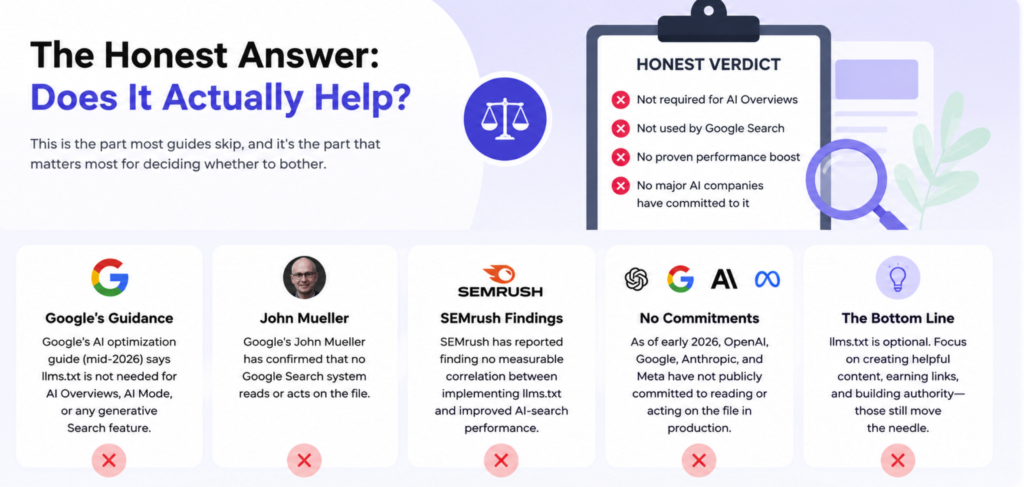
So why do Anthropic, Stripe, Vercel, Cloudflare, and hundreds of other companies publish one anyway? Two honest reasons: it costs almost nothing to create, and it may matter more for agent-facing use cases — AI coding assistants, developer tools, and autonomous agents that fetch and act on content directly — than for general consumer AI search. If your site is a documentation hub, an API reference, or a product where AI agents are a meaningful referral source, the calculus is different than for a typical marketing site.
The practical takeaway: treat llms.txt as low-effort, low-risk insurance — not a ranking strategy. It won’t hurt, it takes about 30 minutes, and if the convention becomes a genuine standard, you’re already there. It should never replace the fundamentals covered in SEO vs AEO vs GEO — that’s where the measurable impact is today; llms.txt is a bet on tomorrow.
The Anatomy of an llms.txt File
The specification is intentionally lean and built on Markdown, since that format needs no complex parsing for a language model to read. A well-formed file follows this structure:
- H1 header — your site or project name, and it must be the very first element in the file.
- Blockquote summary — one to three sentences that precisely describe what the brand or site is. This often becomes the model’s core “mental model” of your site, so it needs to be accurate and specific, not generic marketing copy.
- H2 sections — logical groupings of links (Documentation, Product, Guides, About), each with a short description of what that page covers.
- Optional section — secondary or supplementary links that don’t fit the core sections, placed at the end.
A minimal example:
# Linqivo
> Manual, white-hat link building for SaaS companies — no PBNs, no shortcuts.

## Services
- [SaaS Link Building](https://linqivo.com/saas-link-building-services/): Manual outreach and niche-relevant placements
- [Pricing](https://linqivo.com/pricing/): Flat, transparent per-link and monthly rates

## Guides
- [How to Get Backlinks](https://linqivo.com/how-to-get-organic-traffic-2026/): Step-by-step link building process
How to Create Your Own llms.txt (Step by Step)
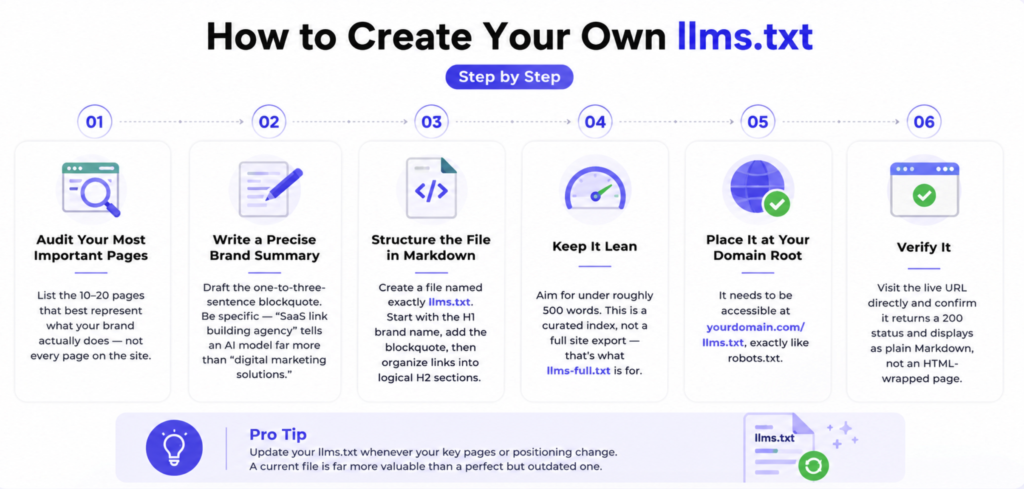
- Audit your most important pages. List the 10–20 pages that best represent what your brand actually does — not every page on the site.
- Write a precise brand summary. Draft the one-to-three-sentence blockquote. Be specific — “SaaS link building agency” tells an AI model far more than “digital marketing solutions.”
- Structure the file in Markdown. Create a file named exactly llms.txt. Start with the H1 brand name, add the blockquote, then organize links into logical H2 sections.
- Keep it lean. Aim for under roughly 500 words. This is a curated index, not a full site export — that’s what llms-full.txt is for.
- Place it at your domain root. It needs to be accessible at yourdomain.com/llms.txt, exactly like robots.txt.
- Verify it. Visit the live URL directly and confirm it returns a 200 status and displays as plain Markdown, not an HTML-wrapped page.
Keeping It Useful, Not Stale
A stale llms.txt file that still points to deleted pages or outdated service descriptions works against you — it’s actively misleading rather than neutral. Build a quarterly review into your existing content calendar, and update it immediately whenever you launch major new pages, restructure navigation, or retire content. This same discipline is what keeps a backlink profile healthy too, as covered in why most backlinks don’t last — an asset that goes stale works against you either way.
Common Mistakes
- Treating it as a full sitemap dump instead of a curated summary — quality of selection matters more than coverage.
- Writing a vague, marketing-heavy blockquote instead of a precise, factual description of what the site does.
- Publishing it once and never updating it as the site changes.
- Treating it as a substitute for real content quality, entity clarity, and backlink authority — llms.txt supplements those fundamentals, it doesn’t replace them.
- Expecting a measurable ranking or citation lift and being surprised when Google’s systems don’t respond to it at all.
FAQ
Is llms.txt an official web standard? No. It’s a community convention with no backing from W3C, IETF, or any recognized standards body, and there’s no enforcement mechanism — adoption is entirely voluntary and inconsistent across AI providers.
Will it improve my Google rankings? No confirmed evidence of that. Google has stated its Search systems don’t use it, and independent testing (including from Semrush) hasn’t found a performance correlation.
Is it still worth creating? For most sites, yes — as a low-effort, low-risk addition, especially if AI agents or developer tools are a meaningful part of your traffic. It should sit alongside real SEO and link building work, never in place of it.
At Linqivo, we treat AI-search readiness the same way we treat backlinks — as something built on real substance, not shortcuts. Our guest posting for AI visibility guide covers what’s proven to move the needle today. See our pricing plans to get started.