How to Check Brand Visibility in ChatGPT (And What Actually Gets You Recommended)
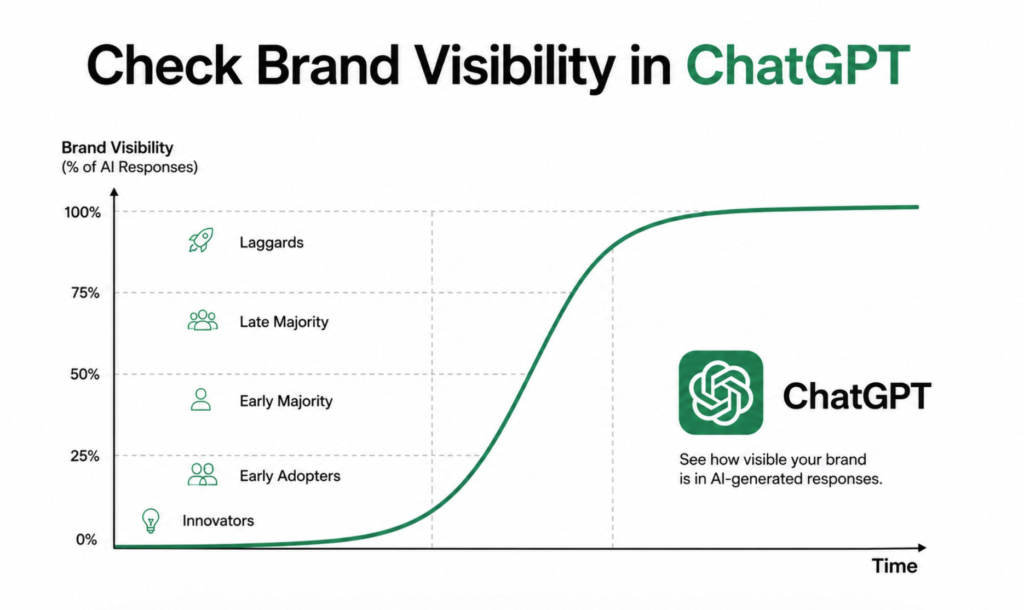
Somewhere right now, a potential customer is typing “best [category] tool for [use case]” into ChatGPT. It answers with three or four names. If you’ve never checked whether your brand is one of them, this is worth ten minutes before reading anything else on this topic.
SEO, GEO, and AEO — What’s Actually Different
Three acronyms get thrown around interchangeably, and they’re not the same thing:
- SEO (Search Engine Optimization) — getting a page to rank in traditional Google results, built around keywords, backlinks, and technical crawlability.
- GEO (Generative Engine Optimization) — getting a brand cited or mentioned inside AI-generated answers (ChatGPT, Gemini, AI Overviews, Perplexity), built around entity clarity, structured content, and third-party authority.
- AEO (Answer Engine Optimization) — a closely related term, usually used for optimizing content to directly answer a specific question format, which overlaps heavily with GEO and is sometimes used as a synonym for it.
The practical takeaway: these aren’t three separate departments. GEO and AEO both lean on the same foundation SEO always has — genuine authority and relevance — applied to a different kind of engine.
How to Actually Check Your Brand’s Visibility
Before optimizing for anything, check where you actually stand:
- Ask ChatGPT directly, in a fresh chat with no prior context, the exact questions a buyer would ask — “best [your category] for [use case],” “alternatives to [competitor],” “[your category] comparison.” Note whether your brand appears at all, and where in the list.
- Check across multiple prompts and phrasings. One test isn’t representative — ChatGPT’s answers vary by how a question is phrased and whether it triggers a live web search or answers from training data alone.
- Test competitor prompts too. If competitors consistently appear and you don’t, that gap is diagnostic — it usually points to a mentions or authority gap, not a product gap.
- Check crawl access. A recent breakdown of ChatGPT’s ranking behavior notes that site inclusion in ChatGPT Search depends partly on allowing OpenAI’s search crawler and published IP ranges — if your site blocks it, you may be invisible regardless of how strong your content is.
- Repeat monthly. AI answers shift as models update and as new content gets indexed — a one-time check only tells you where things stand today.
What Research Actually Shows Drives This
This part matters more than intuition. A 2026 study analyzing 278 prompts across B2B SaaS categories found something counterintuitive: 66% of brand recommendations in ChatGPT happen without the brand’s website ever being cited. Being recommended and being cited are two different outcomes, and they’re driven by different things.
For the recommendations themselves, the same research found the strongest factors were third-party listicle presence, branded web mentions, Reddit presence, and user review count — not domain authority alone. For the narrower case of being cited with a direct source link, the top factors shift toward domain authority, organic performance, content freshness, and entity richness.
Put plainly: showing up in “best of” roundups, review sites, and forum discussions matters as much as — or more than — traditional backlink authority for actually getting recommended, even if it doesn’t always come with a visible citation.
Where Link Building and Guest Posts Fit
This is the part most brands miss when they think about AI visibility as a purely technical problem. If third-party listicle presence and branded mentions are top-tier ranking factors, then the levers that build them are exactly the ones link building has always pulled:
- Guest posts on category-relevant sites put a brand’s name, in context, on pages that function as exactly the kind of third-party source ChatGPT draws from. This is covered in more depth in this guide on guest posting for AI visibility specifically.
- Getting included in existing listicles and comparison roundups — “best tools for X” content — is close to a direct hit on the top recommendation factor the research identified. Earning a mention in this kind of content is a core outcome of genuine outreach-based link building, not something schema markup can substitute for.
- Durable placements matter more here, not less. A listicle mention that disappears in six months stops contributing the moment it’s gone — the same durability standard that makes a backlink worth building in the first place applies directly to AI-citation value.
- Manual, relevant placement over volume. The same white hat, manual process that avoids thin, low-context link farms is what produces mentions genuinely useful to an LLM — a brand name buried in a spun, AI-generated listicle carries far less weight than one placed by a real editor on a real site.
This overlap is also exactly why most generative AI search engine optimization agencies quietly bundle “digital PR and third-party mentions” into their GEO packages — because without it, the technical layer (schema, entity data) has nothing to point to.
What This Means Practically
A brand with strong traditional SEO and zero presence in third-party listicles, review sites, or guest content is optimizing for one AI-visibility factor while ignoring the one research shows matters more for actually getting recommended. The reverse is also true — a brand with scattered mentions but no structured, crawlable content makes it harder for a model to confidently extract and cite it once it does get referenced.
The realistic starting point is treating this as one integrated effort rather than two separate budgets: build genuine third-party mentions through guest posts and relevant listicle placements, keep site content structured and crawlable, and check visibility across ChatGPT, Perplexity, and Google AI Overviews on a recurring basis rather than once.
Linqivo builds guest post and link placements with this dual purpose in mind — the same manual vetting used for traditional rankings, aimed at the mention-graph signals research shows actually drive AI recommendations, with transparent reporting on every placement. Details on pricing are on the pricing page; specific questions about visibility strategy for a given category are worth asking directly through contact.